Not only are psychiatrists doing case identification and diagnoses vulnerable to cultural disorder, but so are the DSM working groups who develop the diagnostic criteria for disorders.
In a new philosophy of psychology research paper, Dr Bruce Long defends philosopher of psychiatry Carol Gould’s arguments that histrionic personality disorder (HPD) should not be included in the current and future editions of the Diagnostic and Statistical Manual for Mental Disorders (DSM5-TR).
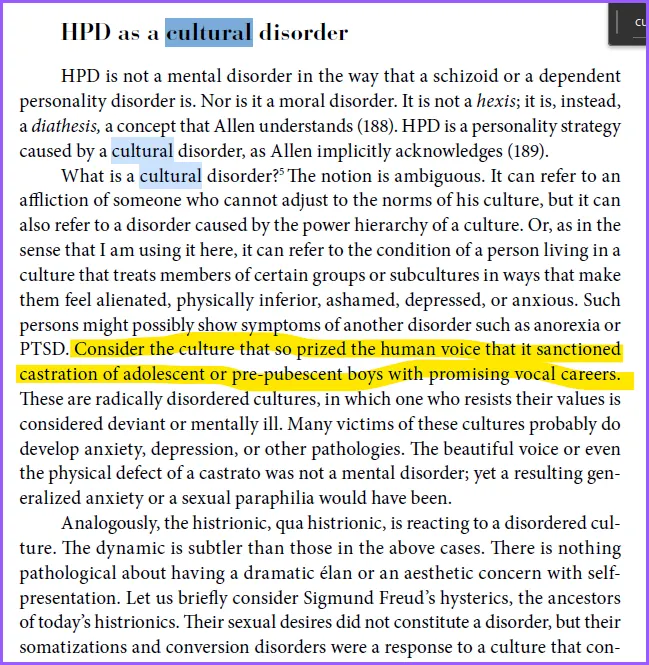
If a therapist believes that their god sees women as inferior, then that’s clearly a cultural disorder by scientific standards. In fact, Long argues in his paper and elsewhere that therapists who have such an imaginary friend in the first place are themselves not just suffering from cultural disorder, but frank mental disorder.
If you have had a diagnosis of personality disorder, it might be best not only to get a second opinion from an independent clinical source, but also to investigate whether the scientific grounds for the disorder are even very reliable in the first place.
It doesn’t follow that such diagnoses must be wrong, but they might be wrong. They are wrong a lot more often than people think, and not just on the basis of malpractice, incompetence, and error.
This is because some significant problems still exist with the categorisation of mental disorders and with the development of dimensional diagnostic criteria (weighted-scoring diagnostic factors for the ‘box ticking’ approach to diagnosis) used for diagnosing them.
Completely putting aside the actual anti-psychiatry movement, of which I am not and avid supporter (I only dislike bad psychiatry and malpractice), there are good reasons known to psychiatrists, psychologists (and philosophers of psychology and psychiatry) why psychiatric diagnosis should be treated with caution.
The first reason is the reproducibility crises, or the replication crisis, which came to be recognised in about 2010. Replicability is the ability for independent researchers to reconstruct a controlled experiment, quasi-experiment, or study according to the instructions of the original designers.
Reproducibility is the ability for independent third party researchers to reproduce the original results with the replicated experiment. In 2010 it was discovered that about 70% of psychological studies were not replicable and reproducible.
That’s not good. It is terrible, in fact.
A second reason to be cautious about any psychiatric diagnosis is that the reproducibility crisis occurred while much of the work done to establish the diagnostic criteria for personality disorders in the DSM5 was in progress. The crises therefore almost certainly had an effect on the inputs and outputs from working groups involved in the process.
The replication crisis also affected— to a lesser extent — the factor analysis done to produce related psychometric tests used in diagnosis. Factor analysis is less vulnerable. It is made more robust because it is based upon rigorous statistical modelling of conceptual schemas that are based upon lexical analysis.
However, lexical analysis involves using the dictionary to find all of the concepts related to a psychological symptom or property. Therefore — if the concepts are affected in the first place by cultural disorder and bad cultural narratives, then even factor analysis can be epistemically polluted and diagnostically corrupted.
It is reasonable to assume that the dictionary will be subject to any disordered narratives that are the basis for culturally disordered concepts that have words assigned to them.
A third reason to treat any psychiatric diagnosis with caution is that both therapists doing diagnosis using psychometric instruments developed with factor analysis and the working groups of researchers responsible for producing the diagnostic criteria of the DSM are vulnerable to disordered cultural influences. As noted above, these corrupting, culturally disordered influences come mostly in the form of cultural narratives and values that permeate societies.
We know that this is true because psychotherapists, being human, are vulnerable to what is called countertransference.
In a clinical psychological setting, transference is when a patient applies emotional responses to the therapist that are inappropriate. These emotional responses usually inappropriately identify the therapist with some other emotionally significant figure in the patient’s life. Examples include regarding the therapist like a parent or developing romantic affection for them.
Countertransference is when the therapist has inappropriate and unhelpful emotional responses to the patient:
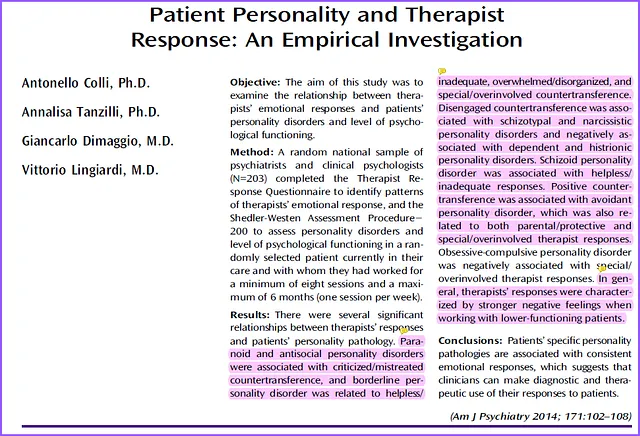
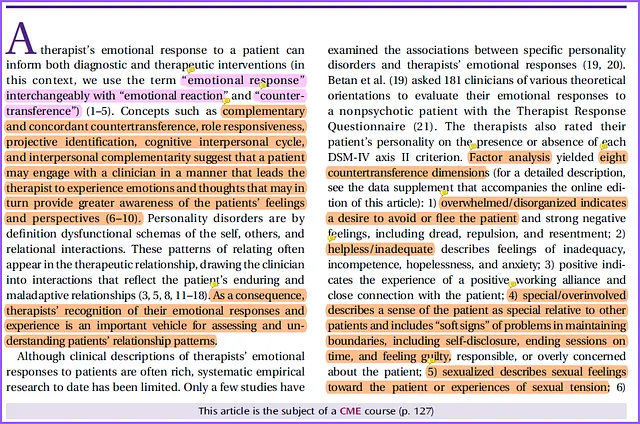
Such countertransference is definitely subject to the personal values and beliefs of the therapist. Such values and beliefs are definitely subject to cultural narratives of the culture in which the therapist is immersed.
In her argument for the exclusion of HPD from the DSM, Gould notes that the root of the cultural disordered-ness is the misogynistic concept of hysteria:
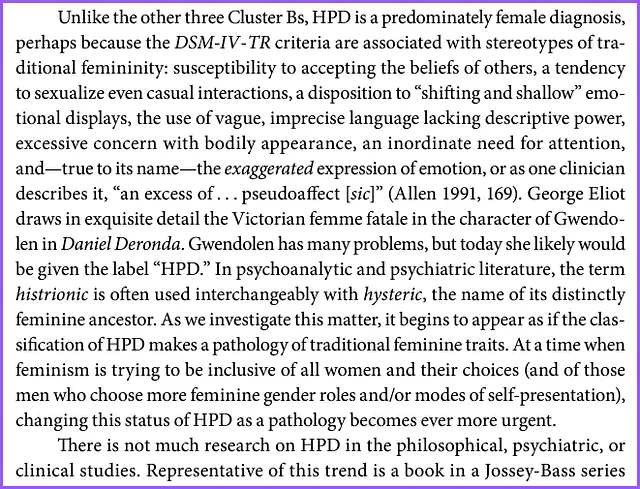
Long defends Gould’s view, and extends the analysis by proposing a criterial system to identify cultural disorders. He also investigates problems with exiting psychometric tests for HPD.
Long is technically an anti-realist about HPD. However, like Gould he suggests that there are two ways in which a patient can be misdiagnosed with HPD. First, the patient might not be suffering any personality disorder at all. In that case the misdiagnosis is due to the cultural disorder afflicting the therapist, and influencing the diagnostic criteria the therapist consequently misapplies. The second option is that the patient is suffering from comorbid personality disorders — but not HPD. Instead, they may be suffering from narcissistic personality disorder and borderline personality disorder.
The history of the DSM involves many revisions. Homosexuality used to be classified as a disorder. Multiple personality disorder is no longer listed as a disorder. In the next version of the DSM it is likely that HPD will be excluded — provided that disordered cultural narratives do not prevail over the highest grades of biopsychosocial evidence in the development of the alleged diagnostic criteria.
References
Gould, C. S. (2011). Why the histrionic personality disorder should not be in the DSM: A new taxonomic and moral analysis. International Journal of Feminist Approaches to Bioethics, 4(1), 26–40. https://doi.org/10.2979/intjfemappbio.4.1.26