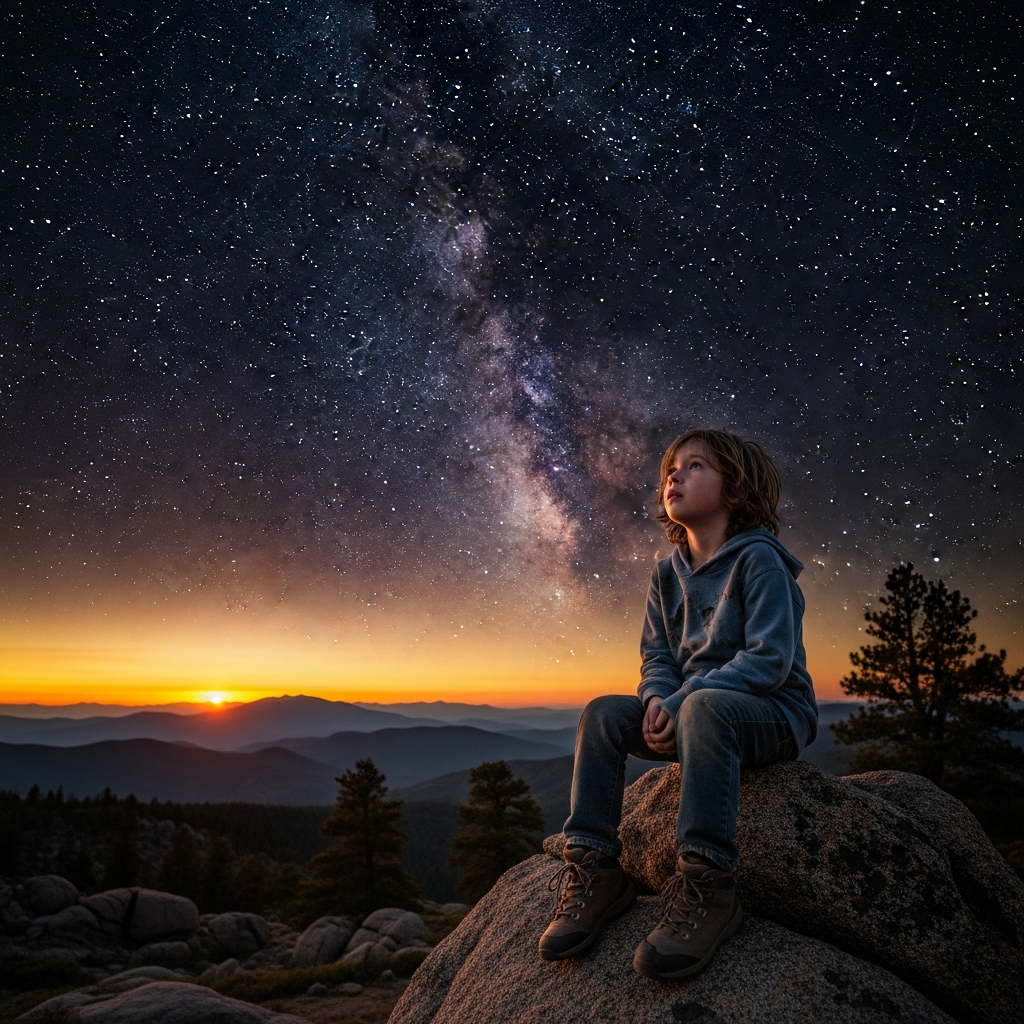
True darkness isn't an absence of light. It is a biological shift in spectral sensitivity that generic generative models cannot emulate.

The Mathematics of Fake Darkness
When a generic text-to-image model is prompted to generate a night scene, it approaches the problem like a novice editor: it simply reduces the exposure. The overall luminance drops, artificial noise is introduced, and a flat blue tint is overlaid across the frame. To a layperson, it looks like night. To a cinematographer—and more importantly, to the human visual cortex—it looks like a forgery.
This is because darkness does not merely reduce the volume of light; it fundamentally changes the chemistry of the eye. NeuraScene's value as a Director's Console lies in enforcing these psychophysical realities rather than approximating their aesthetics.
The Biology of the Purkinje Shift
Human vision operates on two distinct systems. In daylight (photopic vision), our cone photoreceptors are active, with a peak sensitivity to wavelengths around 555 nanometres—the green-yellow spectrum. As ambient illumination declines, the cones saturate and our rod photoreceptors take over (scotopic vision). The rods have a completely different peak sensitivity, anchoring around 507 nanometres in the blue-green spectrum.
This transition creates a robust perceptual regularity known as the Purkinje shift. In mesopic and scotopic conditions, red surfaces appear unnaturally dark, while blue and green surfaces appear artificially luminous. If a generative AI produces a dark alleyway but leaves the luminance ratios of a red brick wall and a blue jacket at their midday photopic values, the image contains a biological lie.
Engineering the Affect of the Night
We operate on the working hypothesis that the Uncanny Valley effect—often manifesting as a subtle sense of dread—stems directly from these precise psychophysical mismatches. When the semantic content of an image tells the brain it is night, but the spectral luminance peaks belong to midday, the visual cortex detects an anomaly. The environment is rejected as synthetic.
By contrast, NeuraScene calculates the Purkinje shift at the rendering level. If you prompt a 1930s gangster film shot on Eastman Plus-X Panchromatic film stock, the ontology engine knows exactly how that specific silver halide emulsion translates the scotopic shift into high-contrast grayscale tonal values. It does not just darken the image; it alters the biological signature of the light.
Grouping in the Shadows
Because scotopic vision lacks the high-frequency detail of the foveal cones, the eye relies heavily on statistical regularities to parse the scene. In the dark, we group indistinct shapes based on their closeness—what traditional Gestalt literature called the Law of Proximity. While the original Gestalt theory of cortical fields is dead, modern vision science has rebuilt this robust grouping phenomenon on the foundation of natural scene statistics and Bayesian inference.
When a scene is lit with biological authenticity, these proximity groupings behave exactly as the brain expects them to. The shadows hide what they are supposed to hide, and reveal what they are supposed to reveal.
The Halo Effect of Optical Truth
Why does this matter for conversion? Because perceptual authenticity is the foundation of trust. This well-replicated psychological mechanism is known as the Halo Effect: when the optics are biologically and physically undeniable, that perception of high quality and competence transfers directly to the brand itself.
You cannot engineer a premium campaign on a foundation of optical slop. If you want to command the viewer's mind, you must first respect the biology of their eye.
Method note. This piece was built in NeuraScene's Advertising Mode using an explicit psychological frame:
- Persuasion trigger: The Halo Effect
- Target affect: Uncanny Valley / Dread
- Gestalt principle: Law of Proximity
Technical directors are highly sensitive to generative 'slop'. Explaining the precise psychophysical mechanism of scotopic vision proves NeuraScene's depth, using the Halo Effect to build trust while avoiding the Uncanny Valley.