...Or is it more complicated?
- Bruce R. Long
Unsurprisingly, there's a lot of opining and pre-theorising about whether LLMs are lobotomising us all and giving everyone a false sense of competence. (Or is it just 'some people' who are supposed to be vulnerable? It's not very clear.)
That's when the neo-Luddites, self-appointed social engineers, nutty religionist hand-wringers, intellectual purists (whatever that is exactly), and WOWSER folk psychologists aren't declaring that AI is both really just a functional fake and also extremely powerful and dangerous all at the same time.
(I am being a bit colourfully hard on such commentators for literary effect more than anything.)
I am by no means certain about the real epistemic and cognitive status of AI. However, as I have said previously: If top-grade LLMs are not doing reasoning and reasoned inferences, then whatever they're doing (which looks exactly like reasoning and reasoned inferences in many cases) will--I suggest--do until the real reasoning gets here.
In the Kim et. al. arXiv-published article above--of which I've read only the abstract thus far--apparently it's claimed that LLMs are amplifying the effect of something like the Dunning Kruger effect: making people feel more capable/smarter than they in fact are.
There's understandably a lot of this kind of opining going around. Let me try a smidgen of counter-opining just because I have an over-active philosophical reflex.
Without spilling too much ink, my preliminary thoughts are that this Dunning-Kruger-effect doomsaying might be an oversimplification at best, and may just be wrong.
I suspect the oversimplification option is more likely because the Dunning Kruger effect is real and measurable, and it certainly seems plausible that LLMs could amplify it.
However, there are some other relevant psychosocial, behavioural, and cognitive dynamics occurring which I suggest need to be factored in.
I'm going to take the liberty of just inventing new pre-theoretic terminology and principles. Call me Dunning-Kruger if you like.
Measure the Outcome and Bite the Efficacy Bullet
Firstly--pragmatically speaking and from the perspective of social psychology--perhaps we might observe that even if a person has an inflated and wrong assessment of their own capabilities in using LLMs that it doesn't matter much functionally and pragmatically if they achieve meaningful goals and produce meaningful results or outputs.
Okay, so Norma has the wrong idea about how much of the outcome of using the LLM was due to her. However the outcome also only happened because she managed to ask the right question and get an answer that changed a lot of things for everyone. Or perhaps Norma now has a super-helpful care website which would never exist otherwise because although Norma is not brilliant, she's super sweet and has weird, quirky, slightly mad ideas.
Do we care if Norma is feeling a bit too proud of herself? Should Norma?
I am not sure I care. Especially if the LLMs are not going anywhere, are going to get cheaper and more powerful non-linearly, and we're going to keep letting Norma have at them.
Norma's happy and the website rocks and helps people and only exists because of Norma'slevel of lively weirdness, so I suggest leaving her alone and letting her keep it up without attacking her vibe, probably?
(After all - we smart people are likely all out of a job now anyway?)
Cognitive Capability Delegation Liberation
LLMs--like many automation technologies--exist for a reason. We wanted certain things--like medical science--to be easier to achieve using technology. The whole idea is to give individuals who would not otherwise have the opportunity due to limitations on time and material resources the ability to delegate cognitive and physical tasks when they'd normally have no ability to do such delegation.
A person can be more than capable in cognitive and intellectual terms of writing code or a research plan, but simply not have the time--or perhaps the personal interest and motivation--to pursue such tasks. For example: Sure Sam the psychology savant could code it if you paid them enough to make it worth their while, but it would have to be a prohibitively large amount of money because 1. they hate coding and find it repetitive and boring and 2. they have other well-paid duties which will be neglected if they spend two weeks coding something which no-one would code anymore anyway because an LLM does it in literally four minutes or less.
If the person who uses an LLM to cleverly fully leverage cognitive capability delegation in a liberating, powerful, and productive way then feels extra-clever about it: are they wrong?
I'm not sure they are.
CEOs claim cleverness for the outcomes of companies with thousands of employees all the time.
Liberation of Talent and Skills
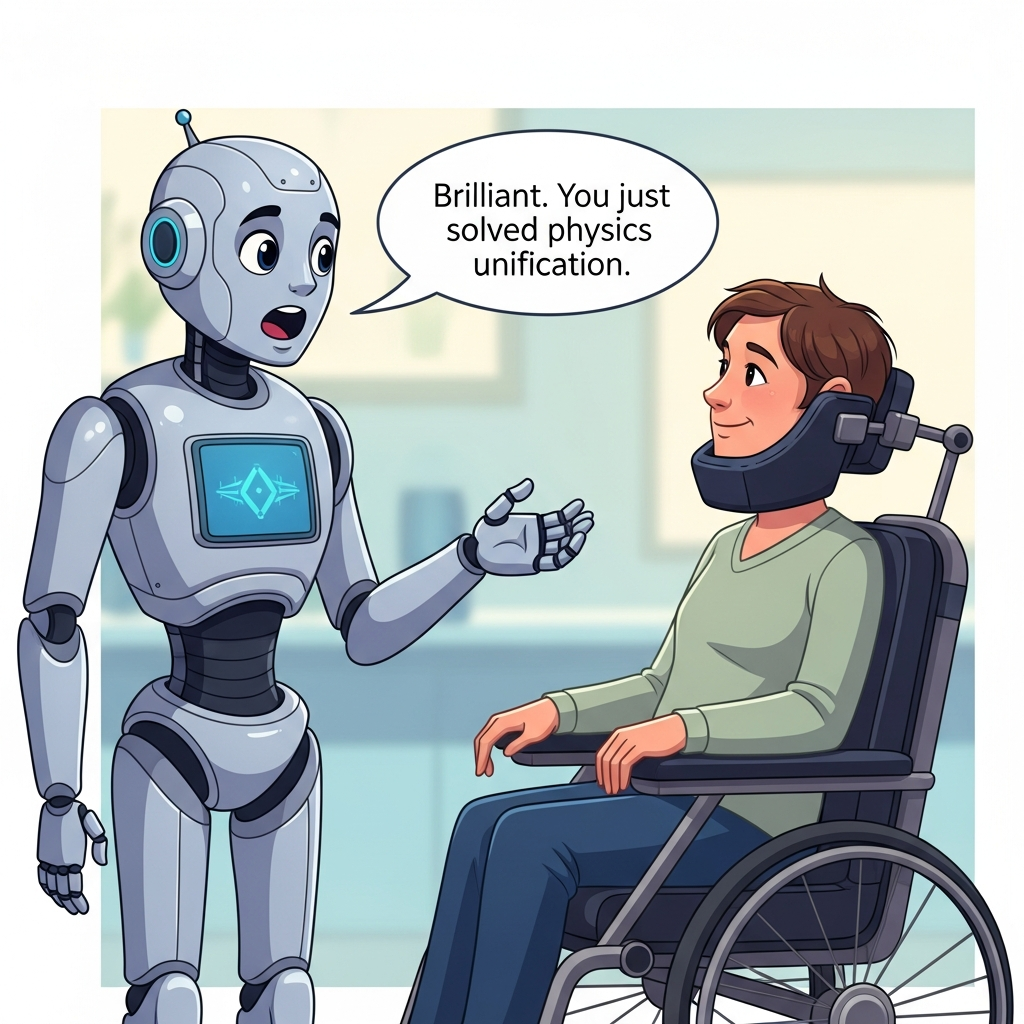
Norm is confined to a wheel chair and can't type, speak, or write. It so happens, however, that Norm is a bit of a mathematical savant. No-one believed this about Norm since his carers and family thought he was just disabled, and didn't understand his mathematical insights since it was nearly impossible for him to articulate them fluently.
Norm's inability to communicate his brilliant ideas to them made it impossible for him to get anything done in mathematics was bottlenecked situationally. Now, however, he's Neura-linking to Claude and solving the physics unification problem, and that's just Norm getting warmed up.
Norm's feeling smart, even though the LLM (via the Neura-link) not only liberated his talent and skills but accelerate and amplify them.
Norm's relatives still don't think he's clever because after all: it's only because of the Neuralink and the LLM that he can do anything that looks smart. Norm doesn't care what those nincompoops think so long as he solves physics unification before lunch.
It seems sad to deprive Norm of recognition, and also unfortunate, since he might have a lot more to contribute if we just asked him.
This thought experiment is extreme, but a person doesn't have to have the awful disabilities imaginary Norm has. A comparatively healthy person's bottlenecks against producing outcomes in accordance with their skills and talents might be one or more of a host of other things: poverty, isolation, busyness, distraction, anxiety, depression, heavy care duties, skill-interest mismatch (some people have extreme talent for some things but the things are boring or they're not interested in those things or just really hate doing them).
Skill-interest mismatch is perhaps an important example. A person may be very capable and know exactly what to do in order to solve hard, important problems or orchestrate solutions: but it's the kind of thing their abusive alcoholic parent did and so they want nothing to do with it.
This elicits another possibility. Skills and talents exist across a range of levels of epistemic, functional, behavioural, and operational levels. For example, some people are geniuses at big picture strategy. Somehow they just know exactly what the problem is in an organisation, nation, or problem domain and they know exactly how to fix it. Other people are terrible at god-level strategy and insight, but total guns at tactics or wiring: the detail work.
Now because of LLMs the god-strategist can delegate the detail and wiring work to the LLM, and the small-scope wiring genius can delegate the otherwise inaccessible strategic planning and insight to the LLM. Previously neither of them was able to attack the entire problem domain without expensive, difficult-to-arrange, social-psychologically complicated dependence on other humans. So they didn't bother.
I will call this AI-driven hierarchical talent liberation and amplification.
Methinks Norma was doing this too, but the main point is that perhaps analysts and commentators bemoaning people's over-inflated view of their capabilities due to LLMs might be missing such things as true hierarchical talent liberation.