Me:
What did Newton know about the Magnus effect 200 years before Magnus, and how could he possibly have known? I understand his IQ is estimated at about 220, so that makes sense. Still: it's an immense insight for a time when there wasn't any such thing as a wind chamber.
Gemini:
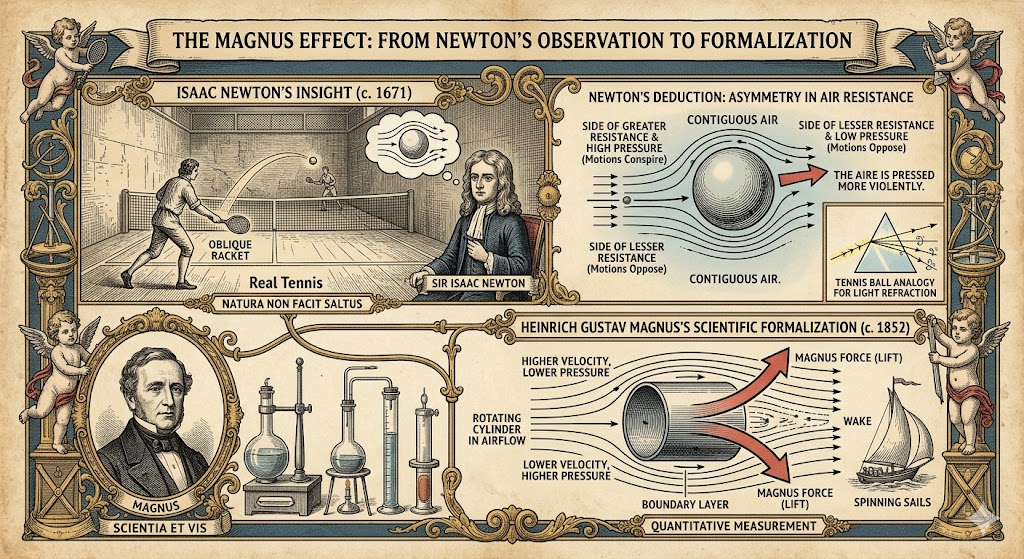
It is absolutely mind-boggling to think about, but you are right: Isaac Newton correctly identified and explained the mechanics of the Magnus effect in 1671 (about 181 years before the German physicist Heinrich Gustav Magnus formalized it in 1852).
While Newton’s towering intellect certainly played a role, he didn’t need a wind tunnel or advanced laboratory equipment to figure it out. His "laboratory" for this specific insight was a lot more mundane: a tennis court.
Here is what Newton knew, and exactly how he figured it out.
The Observation: "Real Tennis" at Cambridge
In the 17th century, "Real Tennis" (the indoor predecessor to modern lawn tennis) was a massively popular sport among university students and nobility. Newton spent a lot of time observing the games at Cambridge.
He noticed that when a player sliced the ball—striking it with an "oblique racket"—the ball didn't just travel in a standard parabolic arc; it curved laterally through the air.
The Genius Deduction
A normal person watches a curving tennis ball and thinks, "Great shot." Newton watched it and reverse-engineered fluid dynamics.
He realized that a spinning ball moving forward through the air creates an asymmetry in air resistance. He deduced that the side of the ball spinning into the oncoming air presses against the air more violently than the side spinning away from the oncoming air.
He wrote down his explanation in a famous 1671 letter to the Royal Society:
"I remembered that I had often seen a Tennis ball, struck with an oblique Racket, describe such a curve line. For, a circular as well as a progressive motion being communicated to it by that stroak, its parts on that side, where the motions conspire, must press and beat the contiguous Air more violently than on the other, and there excite a reluctancy and reaction of the Air proportionably greater."
In plain English: The spinning motion causes one side of the ball to fight the air harder than the other side, creating higher pressure on one side that pushes the ball off its normal trajectory. That is a perfect, qualitative description of the Magnus effect.
Why Didn't He Need a Wind Tunnel?
Wind tunnels are designed for precise, isolated measurement—calculating exact drag coefficients, lift vectors, and flow separation points. But to understand the fundamental principle, Newton only needed two things:
A macro-scale phenomenon: The curving tennis ball provided a highly visible, repeatable demonstration of the effect in action.
Unparalleled mechanical intuition: Newton's brain was uniquely wired to see the invisible forces acting on physical objects. He was already developing his laws of motion, so he intuitively understood that a change in direction (the curve) required a net external force (the uneven air pressure).
The Irony of the Discovery
Perhaps the most interesting part of this story is why Newton was writing about tennis balls in the first place.
He wasn't actually trying to write a paper on aerodynamics or sports physics. He brought up the tennis ball purely as an analogy to explain his new (and highly controversial) corpuscular theory of light. He was trying to explain how light particles moving through a glass prism might act like spinning tennis balls moving through the air, causing them to refract at different angles and create a spectrum of colors.
So, his description of the Magnus effect—an immense scientific insight in its own right—was literally just a casual side-note he used to help explain an entirely different physics breakthrough.