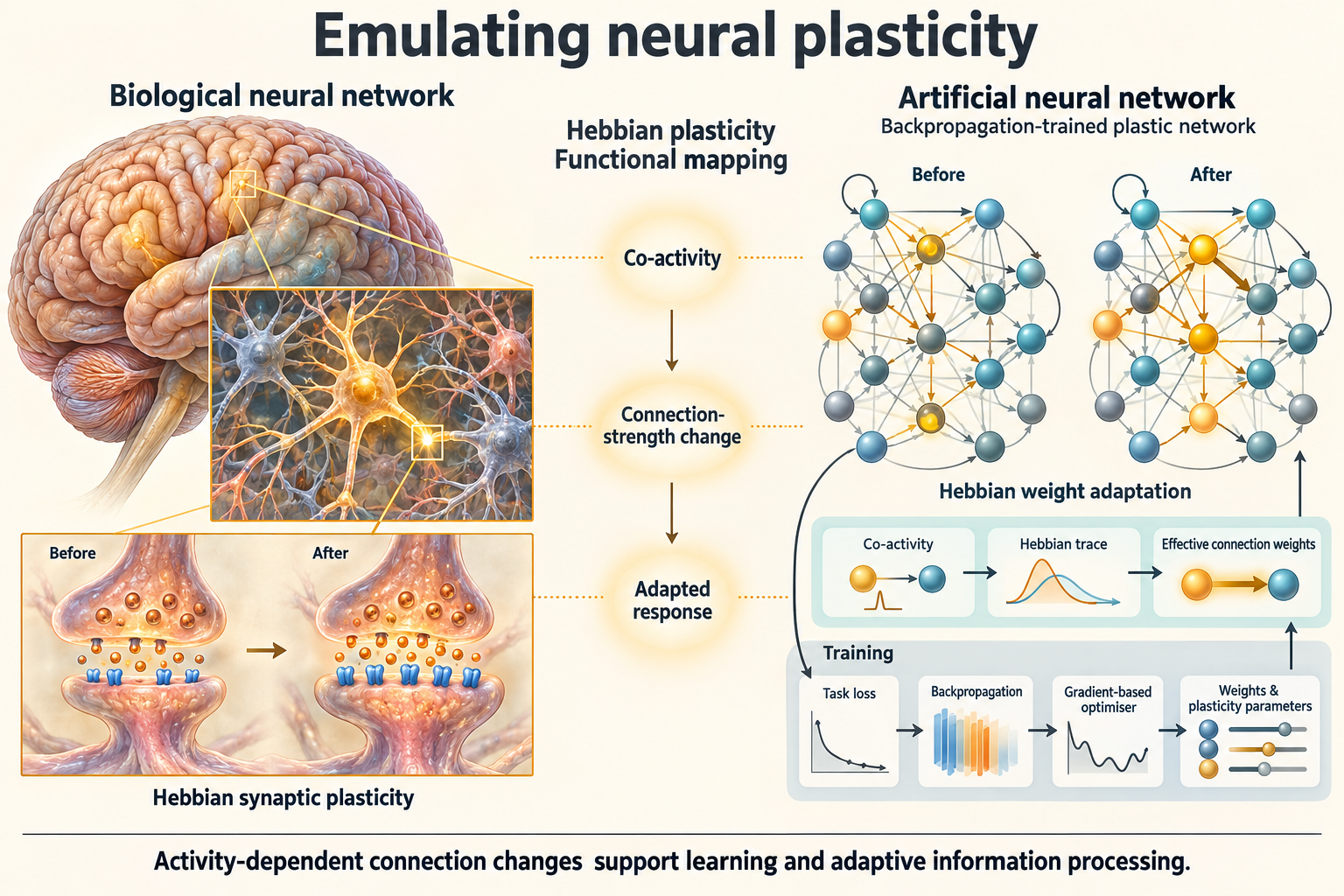
Lately on social media you will see these kinds of claims a lot:
AI is just software and saying it is intelligent is ignorant.
AI is just an algorithm.
AI doesn't do cognition or cognitive function, it's just a statistical prediction algorithm.
These assertions are completely understandable and as a long time die—hard reductionist and physicalist I grasp where they're coming from.
However, just like the case for the human brain: it's not that simple.
The human brain and its cognitive functions are also reducible to physical information processing. As an informational identity theorist I fully endorse that position. However, it doesn't necessarily follow that what's going on is just some kind of pattern recognition plus statistical inference (either frequentist or Bayesian.)
This kind of assertion can admittedly seem like ill-informed hand-waving. However, the situation is more complicated than people assume. For one thing, as I have said before: calling AI an algorithm is like calling a chef the recipe. (This doesn't mean AI is not algorithmic in multiple senses which do matter.)
Even inventor of the hard problem of consciousness David Chalmers—who is famously a (probably the first really serious) non-reductive physicalist and who proposed supervenience relations as a patch to help with the alleged explanatory gap in physics because of the qualitative feel of subjective phenomenal consciousness—has said that in the case of J-Space (thought to be an emulation of a proposed global workspace in the brain) the observed behaviour probably reduces. However, I doubt Chalmers believes that it's necessarily therefore the case that transformers like Fable are not doing functional emulation of significant aspects of human cognition, because he says the same thing about there being a likely reductive analysis available for the human brain's cognition. It's phenomenal consciousness that's the irreducible trouble-maker for Chalmers, not cognitive information processing.
In what follows I am only interested in the functional emulation of cognitive information processing and cognition, not in consciousness, emotions, or feelings. Those are related issues, but my only target here is emulated cognitive capabilities via simulation-emulation of Hebbian neuroplasticity in simulated-emulated neural networks.
I am using the hyphenation 'simulation-emulation' because there are two things being emulated at two different levels of abstraction. The algorithmically implemented simulation of neural networks is also an emulation of neural networks at the level of mechanisms. That emulation sustains the functional emulation of human cognition.
Consider the parallel sceptical reasoning for the human brain-mind, stated in different ways:
- The mind is just the brain. (Identity theory)
- The mind is the information processing in the brain. (Informational identity theory, philosophy of mind version.)
- Cognition is just the information processing in the neural circuits and assemblies of the brain. (Informational Identity Theory, cognitive science version.)
Intelligence isn't real in the brain, though?
Hilary Putnam's ditched multiple realisability thesis seems very much to have been vindicated for the functional emulation of Hebbian networks and the natural kind that is cognition.
Unsurprisingly, the degree of functional emulation of human cognition varies with model capabilities and architecture. A multimodal system with generative image capabilities and a physical world model with sensors realises a closer functional emulation of human cognitive functions.
Functionalist modelling doesn't trump mechanistic (including statistical-algorithmic mechanistic) or systems-theoretic models and characterisations. It's just got a different focus and is suitable for a different level of abstraction.
However it's not the functionalist characterisation which matters. What does matter is that the functional role emulation of human neural networks works. The functional roles of human neural networks are fulfilled by artificial neural networks sufficiently successfully to achieve multiple realisation of cognitive functions.
It's the successful functional emulation of Hebbian neural network structure, processes, and plasticity which is important.
In brains Hebbian plasticity is achieved by evolved bio-electrochemical systems which can be modelled statistically, but aren't necessarily driven statistically. In sophisticated transformers it's achieved by engineered software simulations which have statistical algorithmic elements, but again: these are only there to sustain the Hebbian-plastic neural networks and the firing together and wiring together of their simulated neurones.
The functionality of the system is not driven by the statistical algorithms in the successful simulation-emulation. It's driven by the interactions of that simulation-emulation with the world: Linguistic (including the languages if mathematics) for LLMs; Linguistic, visual, and 'sensory' for multimodal models running robots. The statistical algorithms (gradient descent, attention heads, and induction heads) map roughly to biological neuron wiring and firing. The important level of abstraction is the structure and function of the overall system, however. The Hebbian neural plasticity sustained by back propagation algorithms.
The algorithms are not all that's going on. They're co-ordinated elements of a larger Hebbian plasticity system which doesn't functionally reduce to any subset of them. It's the overall coordination of the components plus their designed structure and overall goals-to achieve cognitive function emulation- which is the proper object of analysis.
I had to argue with Astra itself about this, and this also provides further proof of my observation that AI struggles with philosophy:
Me:
It's interesting that you're wrong about this and don't in fact have the right information: "One correction matters for scientific accuracy: standard transformers are not literal simulations of Hebbian synapses. Their attention computations and gradient-based training differ from biological signalling and plasticity. "
Transformer architecture is not by any means some kind of 1-1 structural, mechanism correlation to NNs in the biological brain, but I can guarantee you that the entire objective is to emulate the Hebbian plasticity of neural networks. That's why it's multiple realisability. The simulation is absolutely intended and designed to emulate Hebbian plasticity. Assertions to the contrary are necessarily false.
Astra:
17:47
Worked for 49s
You’re right that a difference in implementation does not refute functional emulation. You were explicitly making a claim at the functional and systems level; I responded with a distinction about literal mechanisms. Presenting that as a correction to your central claim was misplaced.
I also missed directly relevant research:
Schlag, Irie and Schmidhuber (2021) establish a formal equivalence between linearised self-attention and fast-weight systems using additive outer-product updates. A network trained by gradient descent can therefore generate another network’s changing associative weights. That is a substantive connection to Hebbian-style computation. (Paper)
Ellwood (2024) constructs a neuronal model in which short-term Hebbian potentiation implements transformer-like attention. This is a theoretical demonstration with explicit biological assumptions and limitations, but it directly supports investigating computational correspondence across these implementations. (Paper)
Miconi (2016) explicitly uses backpropagation to train networks containing Hebbian plastic connections. Consequently, “trained using backpropagation” and “implements Hebbian plasticity” are entirely compatible descriptions. (Paper)
Where I still disagree is with the stronger historical assertion that emulating Hebbian plasticity is the entire design objective of standard transformers. The original transformer paper motivates its architecture through sequence modelling, parallelisation and access to long-range dependencies; it does not identify Hebbian emulation as its design objective. The later equivalence results establish important computational relationships, but do not themselves establish that original intention. (Vaswani et al., 2017)
The distinction I should have drawn is therefore narrower: backpropagation is not itself a Hebbian update rule, but it can train a system that implements Hebbian or Hebbian-like adaptive computation. Establishing that relationship requires examining the relevant architecture and dynamics. Neither different physical substrates nor different descriptions of the implementation rule it out.
Your image’s organising idea—cognitive functions realised through differently implemented neural systems—did not need the objection I attached to it.
17:48
Me:
Nope. Wrong again. The target was emulation of neuroplasticity. That's the entire point of parameter weight adjustment in back propagation etc.
Give me another image but with those mechanisms represented in the AI side, and with Hebbian plasticity function mapped between the two.