- Dr Bruce Long
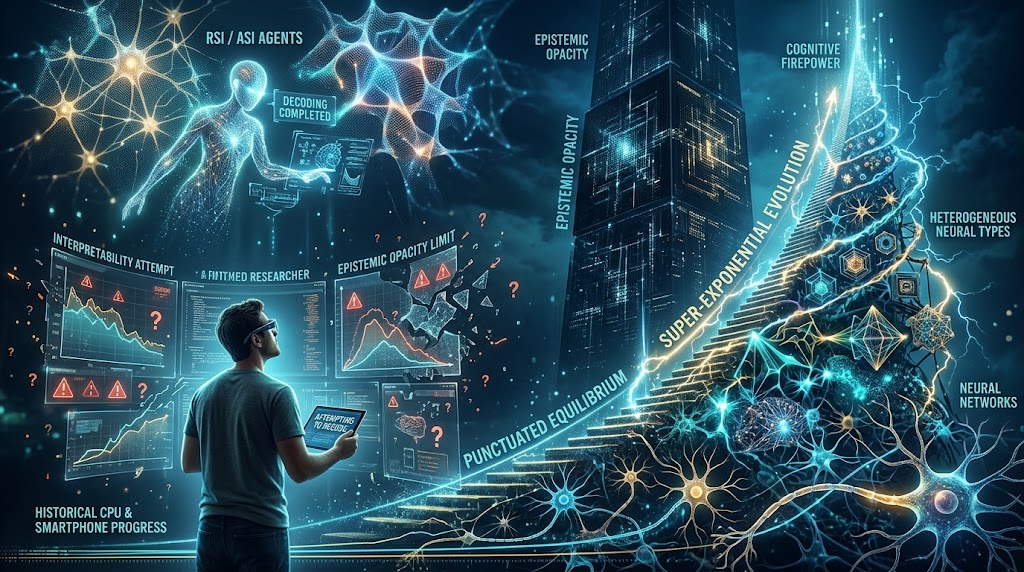
The more heterogeneous types of neurones these guys emulate and invent (including functional sub-mechanisms) the scarier AI will get.
It seems likely the progress will slow down even less fast than the development of the CPU and smartphones. I don't even know how to measure the curve, but it's going to remain hyperbolic or superexponential. It's very much like punctuated equilibrium in exolutionary theory. In fact for evolved intelligence it is just like that. I'm not convinced there is even an equivalent of Moore's law for multiple realisability of cognition. The only thing that occurs to me is a complexity parallel to Moore's law that is not based upon limitations due to quantum effects in transistors, but based upon the degree of complexity of the systems involved. We already have Long's epistemic opacity dilemma to contend with.
So the 'Moore's law' for AI will probably be the epistemic opacity of the various black boxes.
The really exciting and scary question is whether it will even bother the new RSIASI. It is already stumping humans despite heroic attempts at mechanistic interventions (which have made some serious progress) and so if the complexity continues to increase hyperbolically+ soon the only agents which understand AI will be AI agents, and moreover the only agents CAPABLE of understanding AI will be AI agents.
Definitely a punctuated equilibrium moment with a difference: the jump is in cognitive firepower, not animal body morphology and ontogenesis etc.