Or: Surprisal value is the new value
Here is a lovely example of end-to-end information channel testing. Apparently, there are some naughty apps on your smartphone that will monitor your speech and use it for setting up your web search meta data (that’s so bad from a digital ethics perspective).
If you smartphone-talk about pet lizards and pink VWs with your friend Marge, and then suddenly start seeing both VW and reptile store ads in your news feeds: you’re not paranoid (Well — you could also be paranoid, but that is beside the point being made here). Your smartphone apps might well be parsing your speech (which is bad). Honestly: this is a serious digital ethics issue and shows just how far we have already fallen as a civilisation. However, the technique for detecting such misbehaviour is fascinating, and has many applications.
The idea here is simple, statistical, and straight from applied mathematician Claude E. Shannon’ s 1948 the Mathematical Theory of Communication (which statistical theory is still the basis of every communication channel that you use — including your smartphone). The more unlikely a message is overall (to occur), coupled with the more unlikely it is that it matches a previously produced message from a known, prior source: the less likely it is a random occurrence.
If you make up a nonsense phrase like “Unicorn phantabula scudders” in a private message, and it comes back to you several days later via the internet/Web: this is definitely not random. Why, because BOTH the syntax and the semantic content (meaning) are very unlikely given the set of known codes, alphabets, and ‘dictionaries’ of English (even ‘Phantabula scudders’ is extremely unlikely since it has never been recorded in any English text prior to my conjuring it up.)
This is makes for a very powerful and extremely useful tool for detecting hidden information channels and tracing the origin of concepts and terms. For example, you could use this — coupled with Google — to easily determine where the original (shorter) post of this article lives. Can you imagine two people purely accidentally coming up with the exact same neologism-packed line from Lewis Carroll’s ‘Jabberwocky’? (Not if you are not stupid, high, or being a nuisance.)
This is also heuristically and intuitively coherent. It is an outcome that you can guess at unaided by Shannon’s statistical theory because your brain is deploying its own approximate form of predictive, subjective Bayesian updating (roughly — setting your expectations based upon your prior information about how natural language works) to do it.
Shannon’s theory is not Bayesian, nor based upon subjective Bayesian probabilities. It uses frequentist statistics, or frequentism. Frequentism is about counting and ratios rather than updating prior probabilities based on new information as is the fashion with Bayesians. Yet both can kinds of probability can be applied to the situation of interest here.
(For the cognitive scientists out there: I don’t think that the brain literally has a Bayesian inference module that does literal Bayesian calculations. However, its operation when noticing how surprising a phrase or lexical string is can be fruitfully modelled with Bayesian theory.)
The more complex — and the more ‘nonsensy’ — your smartphone-thumbed or blog-inputted phrase, the surer you can be it is not a random occurrence for it (‘phantabula scudders’) to come back to you on the internet through an unrelated channel.
This works for unusual concepts that use familiar English words too. The same principles are applicable, although concepts are probably more difficult to analyse in frequentist terms the way Shannon’s theory does it. This is because there is no digital repository of concepts available for Google (and similar systems) to search to establish a set of frequency scores for each concept as can be done with English words (for which latter application a good online or digital dictionary and a digital library of English books will do.)
It particularly works for neologisms in science fiction texts that constitute what science fiction theorist Darko Suvin would have called a ‘novum’ (Suvin’s own neologism). A novum is a science-fictional ideation or invention that constitutes a plot device. A good example is Ursula K Le Guin’s ‘ansible’, which is a device (and a plot device) in her novel Rocannon’s World which is used for sending messages through spacetime at any distance instantaneously (which would require superluminal signal transmission speeds!)
In other words: it’s going to be easy for a science fiction writer to determine if you have stolen their script. Especially if they use a lot of novum neologisms. (You had better get cracking changing the names of — well — everything. That, in my experience, is what philosophers who steal other scholars’ ideas do!)
Importantly, however, Le Guin’s ansible is an overall less certain example of the kind of statistically surprising novum terms and messages that we are interested in. Why? Because it is less statistically — and subjectively — surprising as a concept in the context of the corpus of science fiction literature: the entire set of science fiction texts. Many science fiction authors (both dead and alive) are interested in the trope of sending messages (or objects) through time, and in time travel, astral projection, and other science fiction and fantasy themes like these.
Thus, although the name ‘ansible’ is very statistically unlikely even in the science fiction genre and corpus: ansible-like devices and meaning are quite common in science fiction (although kudos — and deserved popularity — goes to Le Guin for the ansible because it was unique when she invented it, and it also ‘anticipated’ debates about superluminal information transmission in quantum physics more than two decades later!) The syntax is very unlikely, but the semantic content of such a novum term in the context of the science fiction genre and its texts is somewhat likely in terms of frequency of occurrence: in frequentist statistical terms.
Nonetheless, a novum neologism is a good marker of the novum concept because words and concepts go together an awful lot in natural language. So much so that the basis of all psychometric instruments for measuring personality in psychology are based entirely upon lexical analysis of terms corresponding to concepts of personality traits in English dictionaries! (The results of which analyses are then fed into a more mathematically sophisticated correlational factor-analysis.)
So, a novum neologism’s conceptual content and semantic content is less unlikely for science fiction fans and writers (and literary theorists) as an audience — and individually — when analysed and appraised in subjective Bayesian-updating terms (based upon prior probabilities for certain types of concepts and conceptualisation.) Science fiction readers already have elevated subjective prior probabilities — or expectations — for such concepts. Nevertheless, the more surprising it is conceptually the better it is in aesthetic and literary terms.
Still, a novum neologism — the string of letters — and its accompanying concept(s) are statistically unlikely in frequentist statistical terms when the entire corpus of English literary works and non-fiction writing is used to do the string-frequency counting (the ratio of the number of occurrences of ‘ansible’ to other words when one adds all the English texts ever written together.) It has what philosopher of information Fred Dretske called high ‘surprisal’ value.
In a frequentist sense you are statistically surprised to encounter the improbable lexical string and its meaning. This translates coherently into a Bayesian subjective probability interpretation too, although Dretske did not pursue that approach much. You’re subjectively surprised to see the novum based upon your existing subjective probabilities for such outcomes. Novum neologisms and concepts have high surprisal value.
Suvinian novums are a big part of the basis of the intertextual-aesthetic, scientistic-aesthetic, and cultural-textual appeal of science fiction literature in subgenres like cyberpunk, hard science fiction, and informationist science fiction. In literary terms — both on the frequentist basis and applying a more Bayesian assessment — there is an aesthetic effect associated with high surprisal novums. The more surprising the term and concept are (although it’s clearly mostly about the concepts) the more aesthetically appealing the literary work.
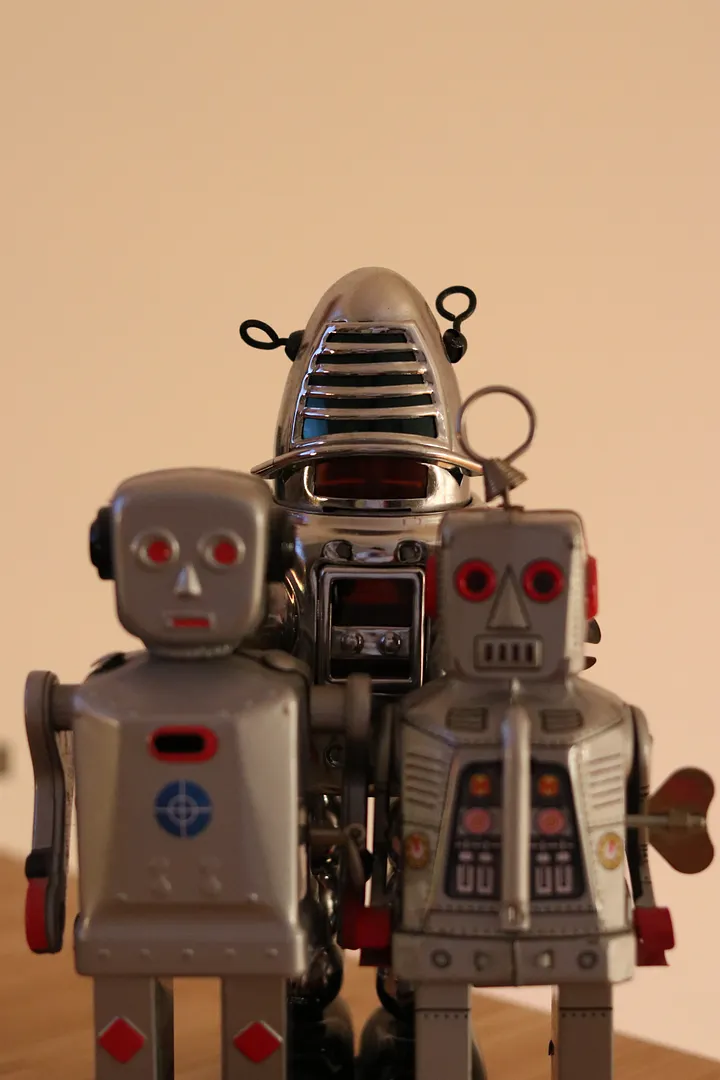
Luddites don’t want to be surprised by nasty technology and science. Science fiction fans, on the other hand, are after that technovum-surprisal-rush. (Hey look. I did another neologism. This one — ‘technovum’ — seems to belong to my weird and arcane science fiction literary theory oeuvre. Apologies to Suvin are in order, probably. I tell you what though: if I see ‘technovum’ anywhere else then I am sending the killer robots around to remonstrate with the offending party. Unless there’s a citation to this phantabulogorical post, that is, in which case: ansible-transmitted virtual love and hugs in advance.)
Science fiction readers enjoy being surprised by scientistic technical, conceptual, and lexical invention — especially when it helps deliver up a highly inventive plot. When a novum with high surprisal value is also a good plot device that increases the inventiveness of the overall plot, character construction, and mise-en-scène then the science fiction text has a good chance of becoming famous literature. Such novums constitute a unique aesthetic that fits with the scientistic trope of the ‘eureka moment’ and the spirit of scientific discovery, which are element of the paradigm, scientistic cultural aesthetic of science fiction.
However, if you’re writing some amazing Michael-Verhoeven-grade informationist science fiction and you novum-up a barabulous neurampusplat or a zardoogifier (personally I don’t really recommend those, specifically) and these nifty neologisms and their accompanying concepts (the mind boggles) come back at you in someone’s blog post or movie script: you’ve very likely been hacked by a hack!
In lieu of a reference list, here is a copy of the Bibliography from my 2009–10 Master of Philosophy thesis Informationist Science Fiction Theory and Informationist Science Fiction.
B i b l i o g r a p h y
Aadrians, Pieter and Johan van Benthem, Philosophy of Information. Amsterdam: North Holland, 2008.
Abramson, Norman. Information Theory and Coding. New York: McGraw-Hill Education, 1963.
Adams, D. Six Stories By Douglas Adams: The Ultimate Hitchhiker’s Guide. New York: Wing Books/Random House,, 1996.
Bacollini, R. And Tom Moylan. Dark Horizons: Science Fiction and the Dystopian Imagination. New York: Taylor and Francis, 2003.
Bakhtin, M. M. “Discourse in the Novel.” The Dialogic Imagination: Four Essays. Ed. Michael Holquist. Trans. Caryl Emerson and Michael Holquist. Texas: University of Texas Press, 1982. 259–423.
— . The Dialogic Imagination: Four Essays. Ed. Michael Holquist. Trans. Michael Holquist. Texas: Texas University Press, 1982.
Bakhtin, M. M. “The Dialogic Imagination.” Ed. Michael Holquist. Trans. Michael Holquist and Caryl Emerson. Texas: University of Texas Press, 1982.
Banks, Iain M. The Algebraist. London: Orbit Time Warner, 2004.
Barnouw, Dagmar. “Science Fiction as a Model for Probabilistic Worlds: Lem’s Fantastic Empiricism” Science Fiction Studies. # 18 = Volume 6, Part 2 = July 1979. March 2009 <http://www.depauw.edu/SFs/backissues/18/barnouw18art.htm>.
Barthes, R. “S/Z: An Essay.” Trans. Richard Miller. Paris: Hill and Wang/Farrar Strauss Giroux, 2000 ( 1975).
Baudrillard, J. “Simulacra and Science Fiction.” Simulacra and Simulation. Trans. Sheila Faria Glaser. Ann Arbor: The University of Michigan Press, 1994 ( 1981).
— . “Simulacra and Science Fiction.” #55 = Volume 18, Part 3 = November 1991, Trans. Arthur B Evans, Science Fiction Studies. November 2008 <http://www.depauw.edu/SFs/backissues>.
Baudrillard, J. “The Precession of Simulacra.” Simulacra and Simulation. Trans. Sheila Faria Glaser. Ann Arbor: The University of Michigan Press, 1994 ( 1981).
Baudrillard, J. Simulacra and Simulation. Trans. Sheila Faria Glaser. Ann Arbor: The University of Michigan Press, 1994 ( 1981).
Baym, N, ed. The Norton Anthology of American Literature. 6th. Vol. B. New York: W.W. Norton and Company, 2007.
Botting, F. “Monsters of the Imagination”. Ed. David Seed. Malden: Blackwell, 2005.
Broderick, D. “New Wave and Backwash.” James, E. The Cambridge Companion to Science Fiction. Ed. E. James and Farah Mendelsohn. Cambridge: Cambridge University Press, 2003. 186–208.
— . Reading By Starlight: Postmodern Science Fiction. London: Routledge, 1995.
— . The Architecture of Babel: Discourses of Literature and Science. Carlton: Melbourne University Press, 1994.
Bubb, Jeffry. Quantum Mechanics is About Information. arXiv:quant-ph/0408020v2. Maryland: University of Maryland, 2004.
Cann, Alan J. Principles of Molecular Virology. London: Academic Press, 2001.
Cartwright, John and Brian Baker. Literature and Science: Social Impact and Interaction. Santa Barbara, Calif: ABC-CLIO, 2005.
Clark, S.R.L. “Science Fiction and Religion.” Seed, David. A Companion to Science Fiction. Malden: Blackwell, 2005. 95–109.
Clarke, A.C. “Earthlight.” The Space Trilogy. London: Gollancz, 2001. 133–345.
Clarke, A.C. “The Sands of Mars.” The Space Trilogy. London: Gollancz, 2001. 345–506.
— . The Space Trilogy: Islands in the Sky — Earthlight — The Sands of Mars. London: Gollancz, 2001.
Clarke, Arthur C. “Islands in the Sky.” Clarke, Arthur C. The Space Trilogy. London: Gollancz, 2001. 1–133.
— . Rendezvous with Rama. New York: Spectra, 1973.
Connor, S. “Introduction”. Ed. Edward James. Cambridge: Cambridge University Press, 2004.
Cordle, Daniel. Postmodern Postures: Literature, Science and the Two Cultures Debate. Aldershot: Ashgate, 1999.
Cowley, S. Terran Trade Authority Handbook: Spacewreck: Ghostships and Derelicts of Space. NewYork…: Hamlyn, 1979.
Cramer, K. “Hard Science Fiction.” James, Edward. in The Cambridge Companion to Science Fiction. Ed. Farah Mendelsohn. Cambridge: Cambridge University Press, 2003. 186–208.
Csicsery-Ronay Jr., I. “Science Ficton/Criticism.” Seed, David. A Companion to Science Fiction. Malden: Blackwell, 2005. 43–59.
Davies, David. Aesthetics and Literature. London: Continuum, 2007
Dawkins, R. The Blind Watchmaker. London: Folio Press, 2007.
Dawkins, Richard. The Selfish Gene. London: Oxford University Press, 1976.
Defoe, D. Robinson Crusoe. London: Modern Library Classics/Random House, 2001.
Delany, Samuel R. “About 5,750 Words.” Delany, Samuel R. The Jewel-Hinged Jaw: Notes on the Language of Science Fiction. New York: Berkley Windhover, 1978.
— . Babel 17. London: Gollancz (Ace), 1987 (1966).
Delany, Samuel R. “Critical Methods.” The Jewel-Hinged Jaw: Notes on the Language of Science Fiction. New York: Berkley Windhover, 1978.
Delany, Samuel R. “Letter to a Critic.” The Jewel-Hinged Jaw: Notes on the Language of Science Fiction. New York: Berkley Windhover, 1978. 8–13.
— . The Jewel-Hinged Jaw: Notes on the Language of Science Fiction. New York: Berkley Windhover, 1978.
Delany, Samuel R. “To Read the Dispossessed.” The Jewel-Hinged Jaw: Notes on the Language of Science Fiction. New York: Berkley Windhover, 1978.
Derrida, Jacques. Writing and Difference. New York: Routledge, 2007 ( 1978).
Devitt, Michael. “On Determining What There Isn’t.” Stich and His Critics. Chichester: Wiley-Blackwell, 2009. 46–61.
Dick, P.K. “Pages from “The Exegesis”.” — — 2003. Philip K. Dick, The Official Site. Philip K. Dick Trust. 28 August 2008 <http://www.philipkdick.com/new_exegesis.html>.
Dick, Philip K. The Philip K. Dick Reader. New York: Kensington Publishing Corp./Estate of Philip K. Dick, 1985.
— . Radio Free Albemuth. Film Tie-in Ed. London: Harper Voyager, 2008 (1976).
— . Do Androids Dream of Electric Sheep. New York: Ballantine Books, 1996 (1968.)
— . “Pages from “The Exegesis”.” — — 2003. Philip K. Dick, The Official Site. Philip K. Dick Trust. 28 August 2008 <http://www.philipkdick.com/new_exegesis.html>.
Dretske, F. “Epistemology and Information.” Adriaan, P. in Philosophy of Information (Handbook of the Philosophy of Science,). Ed. Johan F.A.K van Benthem. Amsterdam: Elsevier B.V., 2008.
— . Knowledge and the Flow of Information. London: Basil Blackwell, 1981.
Duncan, A. “Alternate History.” James, Edward. in The Cambridge Companion to Science Fiction, . Ed. Farah Mendelsohn. Cambridge: CUP, 2003. 230–240.
Freedman, C. “Science Fiction and Utopia.” Patrick Parrinder.in Learning From Other Worlds: Estrangement, Cognition and the Politics of Science Ficton Liverpool: Duke University Press, 2001.
— . Critical Theory and Science Fiction. New England: Wesleyan, 2000.
Frege, G. “Function and Concept.” Sullivan , Arthur. in Logicism and the Philosophy of Language. Toronto: Broadview, 2003. 143–163.
— “On Sense and Reference.” Sullivan , Arthur. in Logicism and the Philosophy of Language. Toronto: Broadview, 2003. 175–193.
Fry, N. The Anatomy of Criticism: Four Essays. Princeton: Princeton University Press, 1990.
Gibson, W. All Tomorrow’s Parties. Victoria: Viking/Penguin, 1999.
— . Idoru. London: Penguin-Putnam, 1996.
— . Virtual Light. New York: Bantam Doubleday Dell, 1993–4.
Goodman, Nelson. Languages of Art. 2nd. Indianapolis: Hackett Publishing Company, 1976.
— . “Sense and Certainty.” The Philosophical Review 61.2 (1952).
— . Ways of Worldmaking. Indianapolis: Hackett Publishing Company, 1978.
Gottlieb, P. “Aristotle on Non-contradiction.” The Stanford Encyclopedia of Philosophy. 15th December 2008 <http://plato.stanford.edu/entries/aristotle-noncontradiction/#1>.
Haggard, H.R. King Solomon’s Mines. Oxford: Oxford University Press, 1989.
Harland, Richard. Beyond Superstructuralism. London: Routledge, 1993.
Harris-Fain, D. Understanding Contemporary American Science Fiction: The Age Of Maturity 1970–2000. South Carolina: University of South Carolina Press, 2005.
Hayek, Alan. “Hájek, Alan. “Interpretations of Probability.” 2007. Stanford Encyclopedia of Philosophy. November 2008 <http://plato.stanford.edu/entries/probability-interpret/>.
Hayles, N. Katherine. “Information or Noise? Economy of Explanation in Barthe’s S/Z and Shannon’s Information Theory.” One Culture: Essays in Science and Literature. Ed. George Levine. Madison: University of Wisconsin Press, 1987. 119–142.
— . My Mother Was a Computer: Digital Subjects and Literary Texts. 2nd. Chicago: University Of Chicago Press, 2005.
— . “Postmodern Parataxis: Embodied Texts, Weightless Information.” American Literary History 2.3 (1990) 394–421.
— . “Unfinished Work: From Cyborg to Cognisphere.” Theory 23.7–8 (2006).
Heinlen, R.A. Starship Troopers. Berkeley: Ace/Berkeley/Penguin-Putnam, 1987.
Hockett, C.F. “The Mathematical Theory of Communication by Claude E. Shannon and Warren Weaver Reviewed by Charles F. Hockett,”. Ed. Sol Saporta. New York: Holt Reinhart and Winston, 1961.
Hoyle, Fred. The Black Cloud. London: Heinman Educational, 1957.
Huxley, A. Brave New World. New York: Buccaneer Books/Harper Collins, 1946.
Iser, W. “Reception Theory”. Ed. Wolfgang Iser. Malden: Blackwell Publishing, 2006., n.d.
— . How to do Theory. Malden: Blackwell Publishing, 2006.
— . The Act of Reading: An Theory of Aesthetic Response. Baltimore: The Johns Hopkins University Press, 1978.
James, E. “Utopias and Anti-Utopias”. Ed. Edward James. Cambridge: Cambridge University Press, 2003.
James, E. and Farah Mendlesohn, The Cambridge Companion to Science Fiction. Cambridge: Cambridge University Press, 2003.
Kellner, D. “Jean Baudrillard.” 2007. The Stanford Encyclopedia of Philosophy. 27 January 2009 < http://stanford.library.usyd.edu.au/entries/baudrillard/>.
Kripke, S. “Naming and Necessity”. Ed. Donald Davidson and Harman. G. Holland: Reidel, 1972.
LaMarque, Peter. “Literature.” The Routledge Companion to Aesthetics. New York: Routledge, 2008 (orig 2001). 571–584.
Laurence and Eric Margolis, S. “Concepts and Cognitive Science”. Ed. Eric Margolis and Stephen Laurence. Cambridge: MIT/Bradford, 1999.
Laycock, H. “Object.” 2006. The Stanford Encyclopedia of Philosophy. 27 November accessed 2008. < http://plato.stanford.edu/entries/object/>.
Le Guin, U.K. A Wizard of Earthsea. London: Penguin, 1968.
Le Guin, Ursula K. The Dispossessed: A Novel. New York: Harper Perennial Modern Classics, 1974.
Lem, Stanislaw. “On Science, Pseudo-science, and Some Science Fiction” Science Fiction Studies. #22 = Volume 7, Part 3, November 1980. January 2009 <http://www.depauw.edu/sfs/review_essays/lem22.htm>.
— . “On The Structural Analysis of Science Fiction” #1 = Vol 1, Part 1, Spring 1973. Science Fiction Studies. February 2009 <http://www.depauw.edu/sfs/backissues/1/lem1art.htm>.
— . “Philip K. Dick: A Visionary Among the Charlatan” # 5 = Volume 2, Part 1, March 1975. Science Fiction Studies. September 2008 <http://www.depauw.edu/sfs/backissues/5/lem5art.htm>.
— . Solaris. New York: Walker Harvest, 1970 (1961.)
Lewis, D. On the Plurality of Worlds. Massachusetts: Blackwell, (1986,).
Long, Bruce. Shannon and Dretske: Information Theory and Philosophy. Honours thesis. Sydney, 2008.
— . “The Ontology of Information.” (2009 (In preparation).)
Lyons, J. Introduction to Theoretical Linguistics. Cambridge: Cambridge University Press, 1968–9.
Lyotard, F. The Postmodern Condition: A Report on Knowledge (Theory and History of Literature Volume 10). Minneapolis: The University of Minnesota Press, 1984.
Mangina, Constantine A, et al. “Modulation of specific brain activity by the perceptual analysis of very subtle geometrical relationships of the {Mangina-Test} stimuli: A functional magnetic resonance imaging {(fMRI)} investigation in young healthy adults.” International Journal of Psychophysiology 73.2 (2009).
McCarthy, C. The Road. London: Picador, 2006.
Menzel, C. “Actualism.” 2008. The Stanford Encyclopedia of Philosophy. <http://plato.stanford.edu/entries/actualism/>.
— . “Possibilism.” 2008. The Stanford Encyclopedia of Philosophy. <http://plato.stanford.edu/entries/actualism/possibilism.html>.
Micklos, D. and Greg A. Freyer. DNA Science: A First Course: Second Edition. New York: Cold Spring Harbour Laboratory Press, 2003.
Moles, Abraham A. Information Theory and Esthetic Perception. Trans. Joel E Cohen. Illinois: University of Illinois Press, 1966 (Trans. of 1958.)
Moylan, Tom. “Look into the Dark: On Dystopia and the Novum.” Parrinder, Patrick. Learning from Other Worlds: Estrangement, Cognition, and the Politics of Science Fiction and Utopia. Duke University Press: Duhram, 2001. 50–71.
Orwell, G. 1984. New York: Signet Classics, 1950.
Palmer, C. Philip K. Dick: Exhilaration and Terror of the Postmodern. Liverpool: Liverpool University Press, 2003.
Parrinder, P. Learning from Other Worlds: Estrangement Cognition and the Politics of Science Fiction and Utopia. Liverpool: Duke University Press, 2001.
Parrinder, P. “Revisiting Suvin’s Poetics of Science Fiction.” Parrinder, Patrick. Learning from Other Worlds: Estrangement, Cognition, and the Politics of Science Fiction and Utopia. Duke University Press: Duhram, 2001.
Paulson, William. The Noise of Culture: Literary Texts in a World of Information. New York: Cornell University Press, 1988.
Peirce, C. S. “Logic as Semiotic: The Theory of Signs”. Ed. Justus Buchler. New York: Dover, 1955.
— . “Philosophy and the Sciences: A Classification”. Ed. Justus Buchler. New York: Dover, 1955.
— . “The Principles of Phenomenology”. Ed. Justus Buchler. New York: Dover 1955, -1940.
Pinker, S. The Language Instinct. London: The Folio Society/Penguin Press, 1994–5.
Porush, David. “Cybernetic Fiction and Postmodern Science.” New Literary History 20.2 (1989): 373–396.
— . The Soft Machine: Cybernetic Fiction. New York & London: Methuen, 1985.
Putnam, Hilary. Renewing Philosophy. Harvard: Harvard University Press, 1995.
Reynolds, A. Revelation Space. New York: Ace/Orion/Victor Gollancz/Penguin, 2000.
Rieder, J. Colonialism and the Emergence of Science Fiction. Middletown: Wesleyan, 2008.
Roberts, A. Science Fiction (The New Critical Idiom). Oxon: Routledge, 2006.
Robinson, Jenefer. “Goodman.” The Routledge Companion to Aesthetics. New York: Routledge, 2008 (orig 2001). 185–198.
Rucker, R. “”Seek The Gnarl” from Guest of Honor address at the International Conference for the Fantastic in the Arts.” 27th March 2005. www.rudyrucker.com. Rudy Rucker. 14 November 2008 <http://www.rudyrucker.com/pdf/icfatalk2005.pdf>.
— . “A Transrealist Manifesto.” 2005. www.rudyrucker.com. Rudy Rucker. 14 November 2008 <http://www.cs.sjsu.edu/faculty/rucker/transrealistmanifesto.pdf>.
— . Mathematicians in Love. New York: Tor Books/Tom Doherty Associates, 2006.
— . Postsingular. Tor Books/Tom Doherty Associates, 2007.
Russell, B. “Descriptions.” Sullivan , Arthur. Logicism and the Philosophy of Language. Toronto: Broadview, 2003. 279–289.
Russell, B. “On Denoting.” Sullivan , Arthur. Logicism and the Philosophy of Language. Toronto: Broadview, 2003. 235–249.
Saussure, F. “Writings in General Linguistics.” Ed. Simon Bouquet and Rudolf Engler. Trans. Carol Sanders and Matthew Pires. Oxford: Oxford University Press, 2006.
Seed, D, ed. A Companion to Science Fiction. Malden: Blackwell, 2005.
Serres, Michel. Genesis. Ann Arbor: University of Michigan Press, 1997 (1982).
Serres, Michel, Bruno Latour and Roxanne Lapidus. Conversations on science, culture, and time. An Arbor: University of Michigan Press, 1995.
Shaffer, E. The Third Culture: Literature and Science. Berlin: W. de Gruyter, 1998.
Shannon, C. “The Bandwagon.” Information Theory, IRE Transactions on 2.1 (1956): 3–3.
Shannon, C. E. and Warren Weaver. The Mathematical Theory of Communication. Chicago: University of Illinois Press, 1998.
Shelley, M. Frankenstein. New York: Simon and Schuster, 2004.
Shippey, T. “Hard Reading: The Challenges of Science Fiction.” Seed, David. A Companion to Science Fiction. Malden: Blackwell, 2005. 11–26.
Stableford, B. “Science Fiction Before the Genre.” James, Edward. The Cambridge Companion to Science Fiction. Ed. Farah Mendelsohn. Cambridge: Cambridge University Press, 2003. 15–31.
Stephenson, N. Cryptonomicon. United Kingdom: Arrow Books, 2000.
— . Snow Crash. London: Penguin, 1992.
Stevenson, R.L. Treasure Island. London: Puffin Books, 2008.
Strahan, J. and Gardner Dozois, ed. The New Space Opera. New York: Voyager, 2007.
Sutin, L. “Biography:Philip K. Dick: 1928–1982.” — — 2003. Philip K. Dick: The Official Site. Philip K. Dick trust. 28 August 2008 <http://www.philipkdick.com>.
Suvin, D. Metamorphoses of Science Fiction. Yale: Yale University Press, 1980.
Tabbi, Joseph. Cognitive Fictions. Minnesota: University of Minnesota Press, 2002.
Tolkien, J.R.R. “The Lord of the Rings: The Two Towers: Book Four.” The Lord of the Rings: One Volume Edition with Index and Appendices. London: Harper Collins, 2001.
— “The Lord of the Rings: The Two Towers: Book Three.” The Lord of the Rings: One Volume Edition with Index and Appendices. London: Harper Collins, 2001.
Vinge, V. “Signs of the Singularity.” June 2008. IEEE Spectrum Online. 5 November 2008 <http://spectrum.ieee.org/jun08/6306>.
— A Deepness in the Sky (Zones of Thought). New York: Tor Books, 1999.
— . A Fire Upon the Deep. New York: Tor, 1992.
— . The Peace War. New York: Tor, 2003.
Volosinov, V.N. “Marxism and the Philosophy of Language.” Trans. Matejka Ladislav and I.R. Titunik. Cambridge: Harvard University Press, 1973.
Weaver, W. ’Recent Contributions to the Mathematical Theory of Communication’. Chicago: University of Illinois Press, 1998.
Weislander, Lars. “DNA-RNA-Protein: Basic: Processing.” 2008. NobelPrize.org. 16th October 2008 <http://nobelprize.org/educational_games/medicine/dna/b/splicing/> <http://nobelprize.org/educational_games/medicine/dna/b/splicing/schematic.html>
Wells, H G. A Modern Utopia. London: Penguin Classics, 2005 (1905).
Westfahl, G. “Space Opera.” James, Edward. The Cambridge Companion to Science Fiction. Ed. Farah Mendelsohn. Cambridge: Cambridge University Press, 2003. 197–208.
Woit, P. Not Even Wrong: The Failure of String Theory and the Continuing Challenge to Unify the Laws of Physics. London: Random House, 2006.
Wren, Sebastian. “The Brain and Reading.” 2009. SEDL. 19 July 2009 <http://www.sedl.org/reading/topics/brainreading.html; http://www.sedl.org/reading/topics/brainreading.pdf>.
Yagisawa, Takashi. “Possible Objects.” 15 April 2005. The Stanford Encyclopedia of Philosophy. 16 9 2008 < http://plato.stanford.edu/entries/possible-objects/#5>.